The heading style determines how your curtain folds, how it hangs, and how it looks — more than the colour, more than the fabric. Here's a clear guide to every heading type and which suits which Dubai interior.
Why the Heading Style Matters More Than Most People Realise
Most people buying curtains spend the majority of their attention on fabric and colour, treating the heading style as a secondary decision. But the heading — the mechanism by which the fabric attaches to the track or pole and forms its folds — has a larger visual impact on the finished curtain than almost any other single factor. Two curtains in exactly the same fabric and colour look like completely different products depending on how they are headed.
The heading also determines the track system required (which affects both cost and installation), the amount of fabric needed (wave heading requires 2.0–2.3× the window width in fabric; eyelet requires 2.0–2.5×; pencil pleat requires 2.5–3.0×), and the physical effort required to operate the curtain. A badly matched heading and fabric combination can result in a curtain that doesn't hang correctly, doesn't draw smoothly, and loses its appearance over time as the folds gradually lose their shape.
Understanding the characteristics of each heading type — its visual profile, its fabric requirements, its track system, and the rooms it suits — is the foundation of a confident curtain choice. The five main heading types used in Dubai's residential market are: wave, eyelet, pinch pleat, pencil pleat, and tab top.
Wave Heading: The Dubai Show-Home Standard
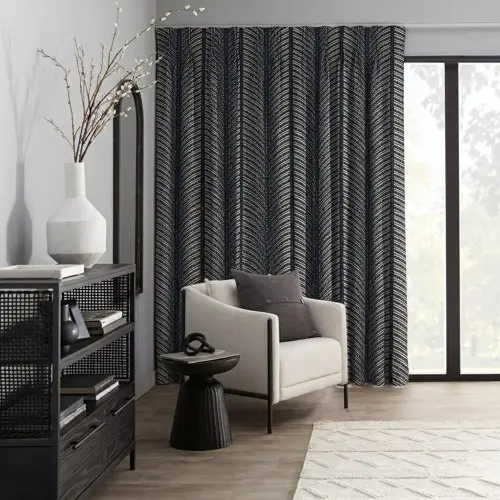
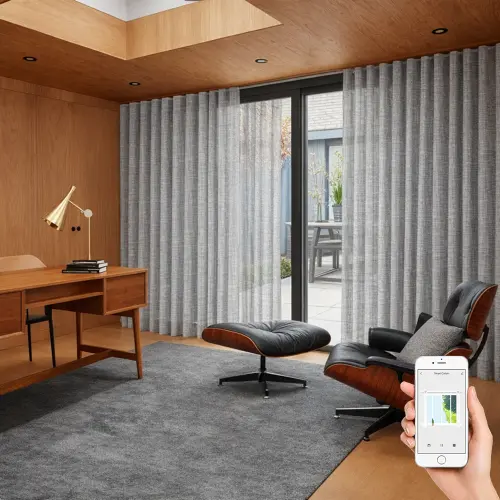
Wave heading creates a continuous S-curve fold across the full width of the curtain panel. Instead of the irregular gathers of a pencil pleat or the grouped clusters of a pinch pleat, wave produces a series of identical, shallow, evenly-spaced curves — a profile that is simultaneously contemporary, geometric, and visually calm.
This is the heading style that dominates Dubai's residential new-build and show-home market. Walk through any premium development handover centre — Emaar, Damac, Nakheel, Meraas — and wave heading in natural linen or charcoal technical fabric is the specification on virtually every window. It creates the clean, uncluttered, almost hotel-like quality that defines Dubai's current interior design language, and it reproduces that look reliably when correctly specified and fitted.
Wave heading requires a specific track: a steel C-rail (also called a wave rail or S-fold rail) with a dual groove that spaces the fabric carriers at the correct interval to produce the wave profile. Standard poles and tracks are incompatible. The track is typically ceiling-mounted or fitted to a top-fix bracket close to the ceiling — which has the additional benefit of eliminating the gap between curtain and ceiling that causes light bleed. The C-rail system is more expensive than a standard pole, but it is also more durable, smoother in operation, and the foundation of a motorized system if that upgrade is made later.
Wave heading requires a fabric with sufficient weight and body to hold the fold. Very lightweight fabrics (thin voiles and sheers) do not hold the wave profile well and tend to flatten over time. The minimum fabric weight for wave is typically 200 gsm; medium and heavyweight linens, technical blackout fabrics, and velvet all work excellently. Wave heading requires a fullness ratio of 2.0–2.3× the window width — less fabric than pencil pleat, but more structure in the fold.
Eyelet Heading: Versatile, Casual, and Widely Used
Eyelet heading uses metal grommets (rings) punched through the top edge of the curtain fabric at regular intervals. The pole passes through the grommets, and the fabric hangs in informal loops between each ring. The resulting fold profile is a series of relaxed, round-bottomed folds — less structured than wave or pinch pleat, but with a consistent rhythm that looks intentional rather than casual.
Eyelet is the most widely used heading in Dubai's apartment market, and its popularity reflects its versatility. It works with standard 35mm or 50mm poles, which are available everywhere and require no specialist track system. Installation is simpler and less expensive than wave. The heading works with a wide range of fabric weights and types — from medium linen to blackout technical fabrics. And it gives a result that is consistently tidy and presentable without requiring the precise fabric selection and track specification that wave demands.
The visual characteristic of eyelet heading — the round, looping folds — suits informal and contemporary interiors. It is the right choice for bedrooms (where the relaxed fold profile suits the private, casual function of the room), casual living rooms, family rooms, and children's bedrooms. It is less suitable for very formal spaces — a formal dining room or a study in a traditional villa where pinch pleat would be more appropriate.
One technical note specific to Dubai: the metal grommets in eyelet heading can become hot when in direct contact with sunlight for extended periods. In a room where the curtains are left drawn against direct afternoon sun (a west-facing living room, for example), the grommets may retain heat into the evening. This is not a structural problem but is worth noting for rooms where people may handle the heading frequently.
Pinch Pleat: Formal, Traditional, and Structured
Pinch pleat heading groups the fabric at regular intervals into clusters of three tightly gathered folds — "pinched" together at the base of each cluster with a stitch that holds the pleats in formation. Between each pleat cluster, the fabric falls in a relatively flat panel. The resulting profile is formal, structured, and traditional — a heading style with a history stretching back centuries in European interior decoration.
In Dubai's residential market, pinch pleat is the right choice for formal spaces that reference classical interior design: traditional Arabic-influenced interiors with ornate cornicing and ceiling details, European classical dining rooms and formal sitting rooms in Jumeirah villas, and entrance halls in large villa developments where a statement curtain treatment frames a significant space. For these applications, wave heading would look anachronistically contemporary; eyelet too casual. Pinch pleat gives the fabric the gravitas the space demands.
Pinch pleat requires a higher fabric-to-window ratio than wave — typically 2.5–3.0×, depending on the fabric weight and the desired fullness of the pleat cluster. This means more fabric per window, which adds to the cost. However, pinch pleat works with any standard hook-and-ring system on both poles and tracks, making the hardware cost the lowest of any heading type.
Pencil Pleat and Tab Top: Practical Everyday Options
Pencil pleat creates a continuous tight gather across the full heading — a series of narrow, uniform pleats that run edge-to-edge. The fold profile is dense and even, giving a more substantial, fuller appearance than eyelet but less formal than pinch pleat. Pencil pleat is the most versatile Dubai heading style: it works on standard poles, corded tracks, and uncorded tracks, making it compatible with virtually any existing installation. It is the standard choice for rental properties because it is easy to hang, easy to remove, and looks presentable in any room.
Pencil pleat requires the highest fabric ratio of any standard heading — 2.5–3.0× the window width — which means it uses the most fabric. This is both a cost factor and a practical consideration: a very wide Dubai window (3m+) in pencil pleat becomes a significant volume of fabric that can be heavy and unwieldy to draw manually. For windows over 2.5m wide, wave or motorized systems are usually the better choice.
Tab top uses fabric loops sewn into the top of the curtain that loop over the pole. It creates the most casual and relaxed heading profile — the fabric falls in informal, large, round folds that are deliberately imprecise. Tab top is the right choice for casual spaces (children's playrooms, outdoor living areas, utility rooms) where a relaxed, informal look is the priority and ease of installation or removal matters. It is not typically used in formal or premium residential spaces in Dubai's market.
Choosing the Right Heading for Your Dubai Room
The decision framework is simple: start with the room's formality level and the visual character you're trying to create, then check the practical constraints (existing track or pole, fabric weight, window width).
For a contemporary Dubai apartment living room: wave heading in medium-weight linen on a ceiling-mounted C-rail. This is the specification that delivers the premium, show-home appearance that most Dubai apartment residents are aiming for.
For a Dubai bedroom (any style): eyelet in blackout-lined linen or technical blackout is the practical standard choice. If budget and the window size allows, wave heading on a motorized C-rail is the premium upgrade that delivers both the best aesthetic and the most consistent blackout performance.
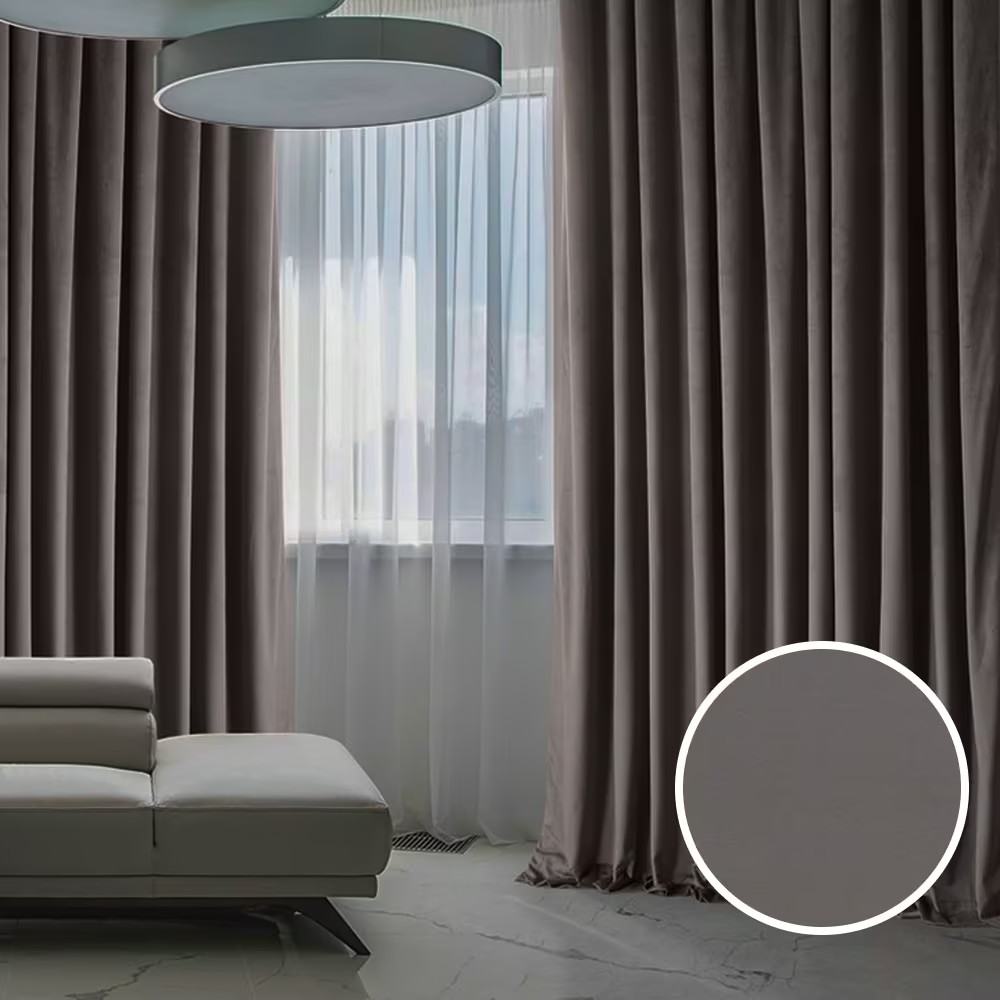
For a formal villa dining room or entrance hall: pinch pleat in heavyweight linen or velvet with interlining. The formality of the heading matches the formality of the space; the fabric weight and interlining deliver acoustic and thermal performance appropriate for the UAE climate.
For a rental apartment or investment property: pencil pleat in a standard-lined mid-range linen. Easy to install, presentable, and compatible with any standard track or pole system — the specification that delivers the best value in a property where curtain specifications will need to be practical for multiple occupants over several years.
- The heading style has more visual impact on the finished curtain than fabric colour — two identical fabrics look completely different with different headings
- Wave heading is the Dubai show-home standard — it requires a specific C-rail track, cannot be used with standard poles
- Eyelet is the most versatile Dubai heading — works with any standard pole, suits any bedroom or informal living space
- Pinch pleat is the formal choice — correct for traditional villa interiors, Arabic-influenced formal rooms, and entrance halls
- Pencil pleat uses the most fabric (2.5–3× window width) and is the standard choice for rental properties
- For windows wider than 2.5m, wave on a motorized C-rail is preferable to pencil pleat — the fabric volume in pencil pleat becomes heavy and impractical
Frequently Asked Questions
Get Expert Advice at Your Home — Free
Our specialist brings samples, measures every window, and gives you a written quote — no obligation.