Dubai's sunlight, climate, and high-ceiling apartments demand a completely different approach to curtains than most buying guides assume. This is the guide written specifically for Dubai.
Why Dubai's Light and Climate Change Everything
Dubai receives 3,509 hours of direct sunlight per year — one of the highest figures on earth. Summer temperatures hit 48°C. Between May and August, sunrise arrives before 5:30am and the morning light is intense enough to illuminate a room like a floodlight by 6am. These aren't weather statistics to skim past: they are the defining parameters of every curtain decision in a Dubai property.
Almost all curtain advice available online originates from Europe or North America, where overcast skies and weak winter sun make "light filtering" a meaningful design choice. In Dubai, an unlined or lightly constructed curtain that works perfectly well in a London living room is effectively transparent against the morning sun by 7am. The fabrics, linings, and constructions required here are fundamentally different — and understanding this gap is where good curtain decisions start.
There is a second factor that most buyers underestimate: energy. Dubai properties run air conditioning systems for eight to nine months of the year. A properly lined window treatment can reduce solar heat gain through glass by 30–40%. In a south or west-facing apartment in Business Bay or JBR, that difference is directly visible on your DEWA bill. The right curtain choice in Dubai is not just aesthetic — it is an investment in comfort and energy efficiency that pays back year after year.
The Five Curtain Types Dubai Homes Actually Need
Blackout Curtains — The non-negotiable for any Dubai bedroom. A genuine blackout curtain achieves total darkness when drawn: no light bleed around edges, no glow through the fabric. This is achieved either through a triple-weave construction (the fabric itself blocks light through weave density) or a coated blackout lining applied to the back of the face fabric. Both work; triple-weave drapes more naturally and lasts longer, while the coated approach upgrades any face fabric to blackout performance. For Dubai's 5:30am summer sunrise, anything less than true blackout in a bedroom is inadequate.
Sheer Curtains — The living room workhorse of Dubai apartments. A well-chosen sheer filters intense afternoon sun into a soft, diffused interior light — reducing glare and UV exposure while preserving the views of the Arabian Gulf, Dubai Marina, or a villa garden that residents pay a premium for. Because exterior light levels in Dubai are so high, even a relatively open-weave sheer provides strong daytime privacy: the interior reads darker from outside than would be the case in a lower-light city.
Linen and Natural Fabric Curtains — The most purchased curtain fabric in Dubai across all price points, and for good reason. Natural linen is temperature-regulating (cooler near a window in direct sun than synthetics), resistant to static and dust accumulation (critical in Dubai's dusty environment), and carries a textured, organic quality that works in both contemporary Marina apartments and traditional Jumeirah villas. Pair it with any lining — from unlined for a casual, airy look to blackout-lined for full performance.
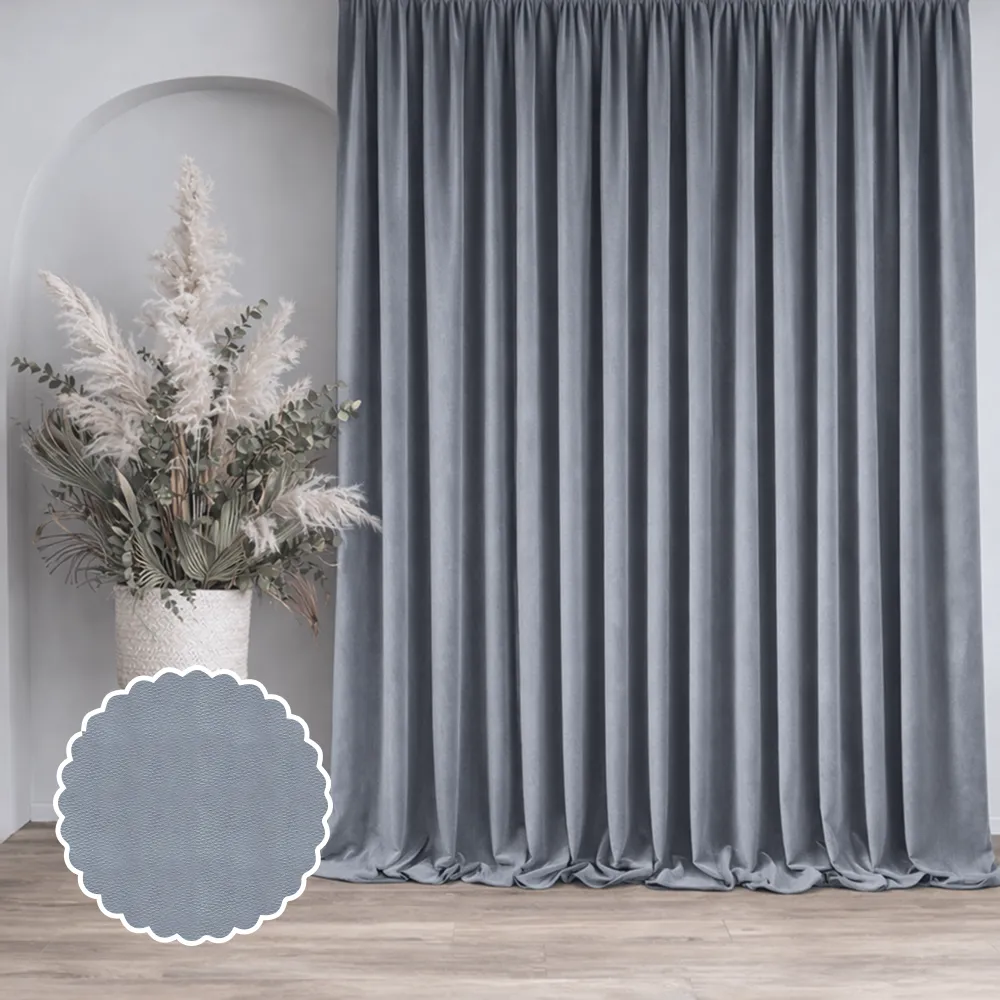
Velvet Curtains — Often overlooked in hot climates, but highly practical in Dubai because properties run on air conditioning for most of the year. The main objection to velvet — it traps heat — largely disappears in a climate-controlled interior. Velvet is one of the most effective acoustic materials in soft furnishings, absorbs light through its pile density, and adds a depth and richness to formal spaces that no other fabric achieves at a comparable price point.
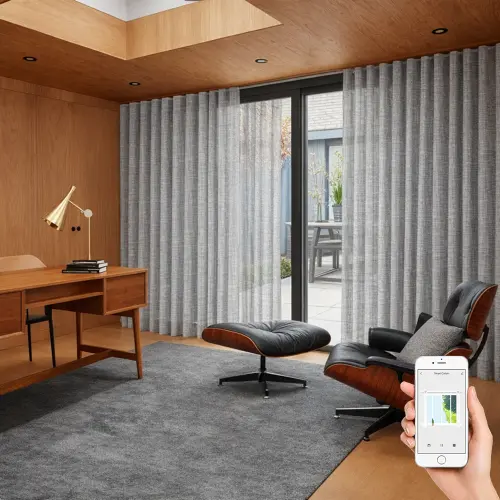
Motorized Curtains — No longer a luxury specification: increasingly the standard in new Dubai residential developments, and a practical upgrade for any home with windows wider than 2.5 metres. App control, voice integration with Alexa, Google Home, and Apple HomeKit, and schedule automation are all achievable. For a 3.5m wide floor-to-ceiling window in a Dubai Marina penthouse, manual operation is genuinely impractical on a daily basis.
Room-by-Room Curtain Guide for Dubai Properties
Master Bedroom: Blackout performance is non-negotiable, full stop. Choose blackout as your baseline requirement, then select face fabric and colour based on interior preferences. Linen with blackout lining gives you the natural texture and warmth of linen with complete light blocking. Navy or charcoal wave heading in blackout-lined fabric is the most popular master bedroom combination in premium Dubai apartments right now.
Children's Rooms and Nurseries: Full blackout is even more critical here than in adult bedrooms. Children's sleep quality is directly tied to darkness, and in Dubai's light-intensive environment a non-blackout curtain in a child's room will result in 5am wake-ups through the summer months. Choose a fun, characterful face fabric with coated blackout lining — the colour and pattern visible from inside the room, the complete darkness delivered by the lining.
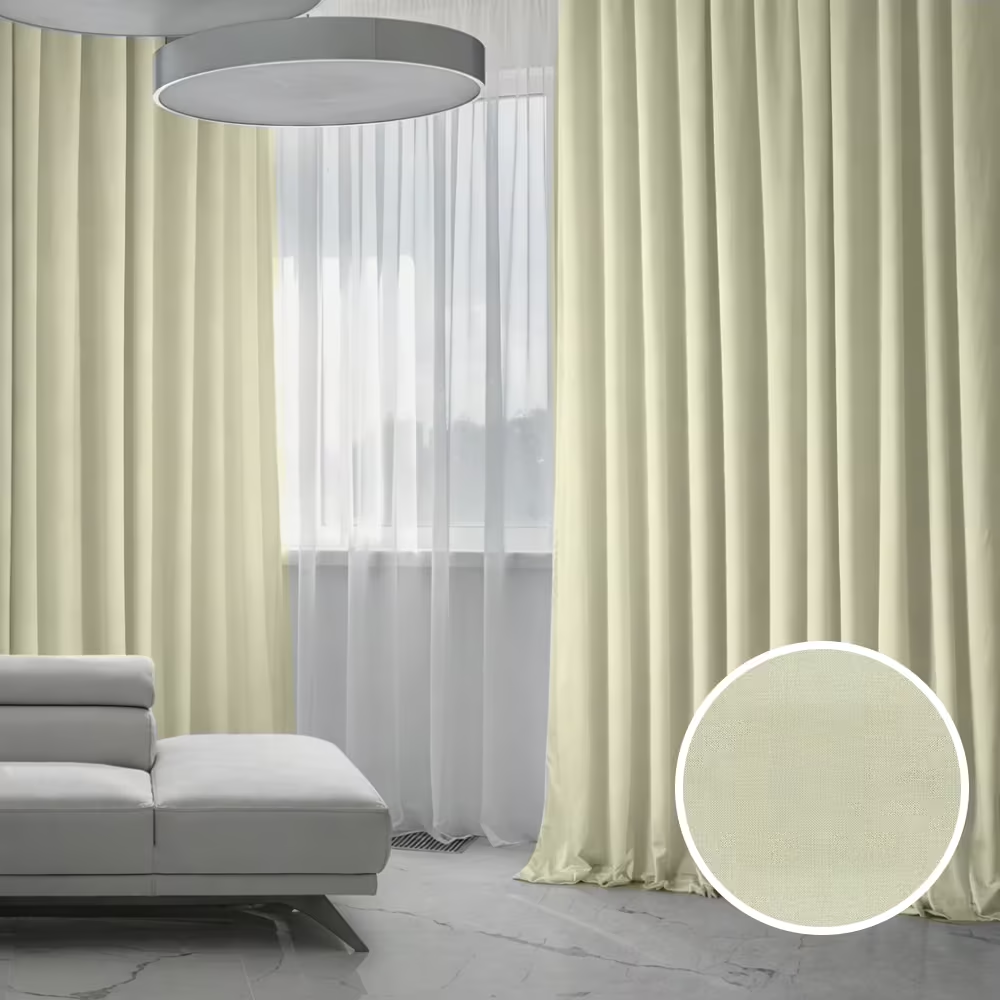
Living Room: A sheer layer for daytime is almost always the right choice — it softens the light, provides privacy, and preserves views. Add a heavier fabric or blackout layer on a double track for evenings or for rooms receiving intense afternoon sun through west-facing windows. Wave heading in natural linen on a double track, with ivory sheer behind, is the single most popular curtain combination in Dubai living rooms.
Home Office: Anti-glare performance matters more than full blackout. Choose a medium-weight fabric with 70–85% light reduction to control screen glare during working hours without creating a completely dark environment. A light linen in wave or pencil pleat, without blackout lining, typically achieves the right balance for a north or east-facing home office.
Dining Room: Formality and acoustic performance are the priorities here. Pinch pleat or wave heading in a medium-to-heavyweight fabric with interlining delivers the right visual weight and provides meaningful noise reduction — particularly important in Dubai apartments where dining rooms are often adjacent to busy building corridors.
Heading Styles: Wave, Eyelet, Pinch Pleat and What Suits Dubai
The heading is how the fabric attaches to the track and how it folds when drawn. It has a disproportionate effect on the finished appearance of the curtain — more than the fabric colour or even the fabric type in many rooms.
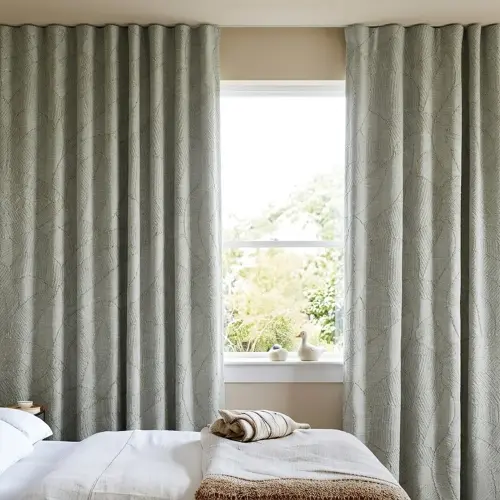
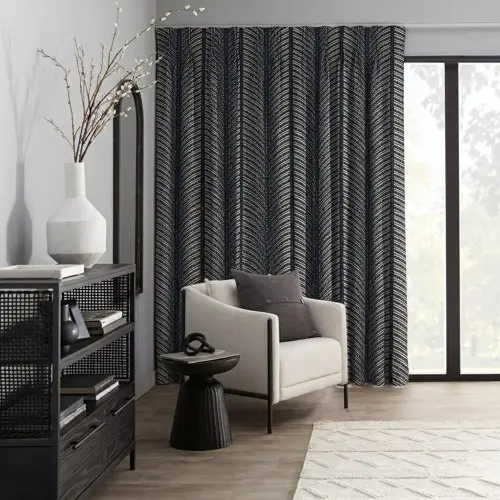
Wave heading creates a continuous S-fold profile with uniform, shallow, even folds across the full width of the curtain. It is by far the most popular choice in contemporary Dubai interiors, dominating show home specifications and new-build developments across Downtown Dubai, Dubai Hills, and the Marina. Wave requires a specific compatible track (typically a dual-grooved C-rail) and needs a fabric with sufficient weight to hold the fold — unlined sheers don't work well with wave. When it works, it creates a clean, hotel-quality profile that elevates any room.
Eyelet heading uses metal rings punched through the top of the fabric, creating a relaxed, slightly informal loop-fold. It is the simplest heading to install, works with any standard pole, and is the most popular choice for bedrooms and casual living spaces across Dubai's apartment market. Eyelets don't require a special track — a standard 35mm or 50mm pole is sufficient.
Pinch pleat creates groups of three or four pleats evenly spaced across the heading. It is the most formal option — the right choice for traditional Arabic-influenced interiors, classical European dining rooms, and entrance halls in Emirates Hills and Palm villas. Pinch pleat works with standard hooks and rings on a pole or track.
Pencil pleat is the most versatile heading: a tight, narrow gather across the full width that works on any pole or track. It is the standard choice for rental properties because it is easy to remove, replace, and adjust. Less dramatic than wave or pinch pleat, but consistently neat and professional.
How to Buy Curtains in Dubai — The Process That Gets It Right
The most common curtain purchasing mistake in Dubai is choosing fabric from a photograph or showroom sample under artificial lighting and ordering without seeing it in the actual room. Fabrics that look perfectly calibrated in a showroom can appear completely different when exposed to Dubai's morning sun in a south-facing room, or under the warm glow of a Dubai villa's evening lighting. This is the root cause of the majority of disappointed curtain purchases in this market.
The process that consistently delivers the right result: a free home visit with a specialist who brings a focused range of samples relevant to your room, assesses them in your actual light at the time of day the room receives its typical exposure, measures every window precisely, and provides a written quote. This is the process we follow for every Dubai home we work with — from a studio apartment in JLT to a six-bedroom villa in Arabian Ranches.
After the home visit: production of your chosen fabrics (typically 7–14 working days), delivery of hardware and fabric to site, and professional installation by our fitting team. A 12-month workmanship guarantee covers every fitting. For large projects — full villa fit-outs, new-build completions, investment property packages — we offer coordinated project management across all rooms.
- Blackout curtains are essential for all Dubai bedrooms — sunrise before 5:30am in summer makes anything less inadequate
- Sheer curtains provide effective daytime privacy in Dubai because the high exterior light level makes interiors appear dark from outside
- Linen is the most versatile fabric — available in every lining from unlined to full blackout, and resistant to Dubai's dust environment
- Any window wider than 2.5m should be considered for motorized operation — manual drawing becomes impractical at scale
- Wave heading dominates Dubai show homes and new-builds — it requires a specific track and a fabric with enough weight to hold the fold
- Never choose curtain fabric without viewing samples in your actual room during daylight — showroom and photograph appearances are completely unreliable
Frequently Asked Questions
Get Expert Advice at Your Home — Free
Our specialist brings samples, measures every window, and gives you a written quote — no obligation.