Choosing the right curtain fabric is the single most consequential decision in any Dubai home. This guide covers every major fabric type — what it does, where it works, and what to avoid in the UAE climate.
Why Fabric Choice Matters More in Dubai Than Anywhere Else
The curtain fabric is the component of a window treatment that is most visible, most touched, and most affected by Dubai's environment. It is also the component with the widest quality range in the market — a gap that is larger in Dubai's curtain trade than in most other cities, because the imported fabric market is less regulated and harder for buyers to assess without specialist knowledge.
Dubai's climate creates specific performance requirements that most global fabric advice doesn't address: UV intensity that degrades synthetic and natural fabrics at different rates and timescales; dust that accumulates differently on different weave structures; static from synthetic fabrics that makes Dubai's fine desert dust actively attracted to the curtain surface; and the thermal interaction between the fabric, its lining, and a glass window receiving direct sun at temperatures that would be considered extreme in almost any other market.
Understanding the main fabric categories — what each one is made from, how it performs in Dubai's specific conditions, what linings it takes, and which rooms it suits — is the foundation of every curtain decision that follows. This guide covers the six major fabric categories used in Dubai's residential curtain market in 2026.
Linen: The Dubai Market Default — and Why That's Justified
Natural linen is the most purchased curtain fabric in Dubai by a wide margin, and the reasons are specific to this market. Linen generates no static, so it doesn't attract Dubai's fine desert dust the way polyester and viscose blends do. It is naturally temperature-moderating near hot windows. It takes every lining option cleanly — unlined for sheers, standard-lined for living rooms, blackout-lined for bedrooms, interlined for the highest thermal performance. And its texture and natural colour palette align precisely with the warm, organic, Mediterranean-adjacent interior aesthetic that dominates Dubai's premium residential market.
The quality range within "linen" is wide. Belgian and Irish linen from established mills — Libeco, Thomas Ferguson, McNutt — uses long-staple flax fibres that produce a consistent, dense weave with excellent colour retention and UV resistance. Lower-cost linen from Asian mills uses shorter-staple fibres and produces a coarser, less even hand that fades faster and wears less gracefully over time. In Dubai's UV-intensive conditions, this quality difference shows within 18–24 months of installation — the premium mill fabric maintaining its appearance; the lower-cost alternative showing colour shift and weave degradation.
For most Dubai rooms — living rooms, bedrooms, dining rooms, studies — medium-weight linen (280–380 gsm) with appropriate lining is the baseline recommendation. For rooms where a statement or dramatic quality is required, move to velvet. For rooms where light diffusion is the priority, move to sheer. Linen handles everything in between.
Velvet: The Acoustic and Visual Premium
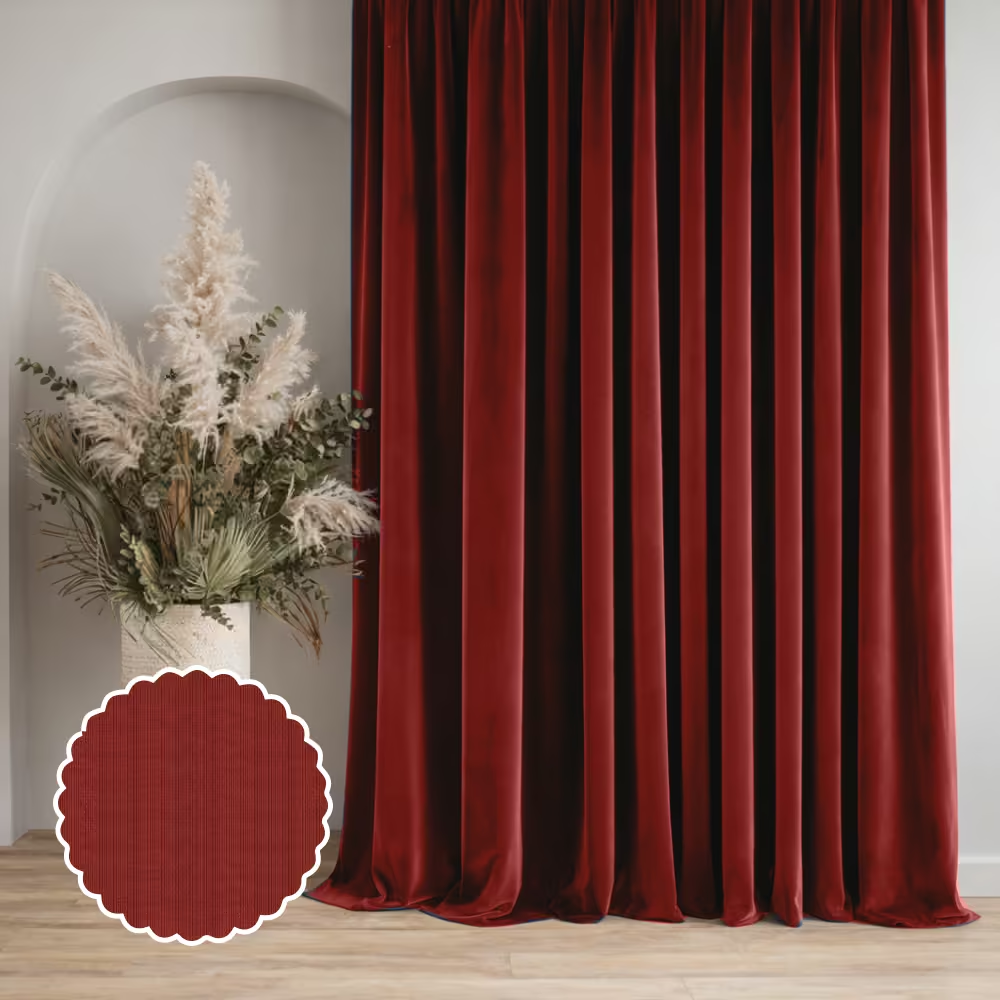
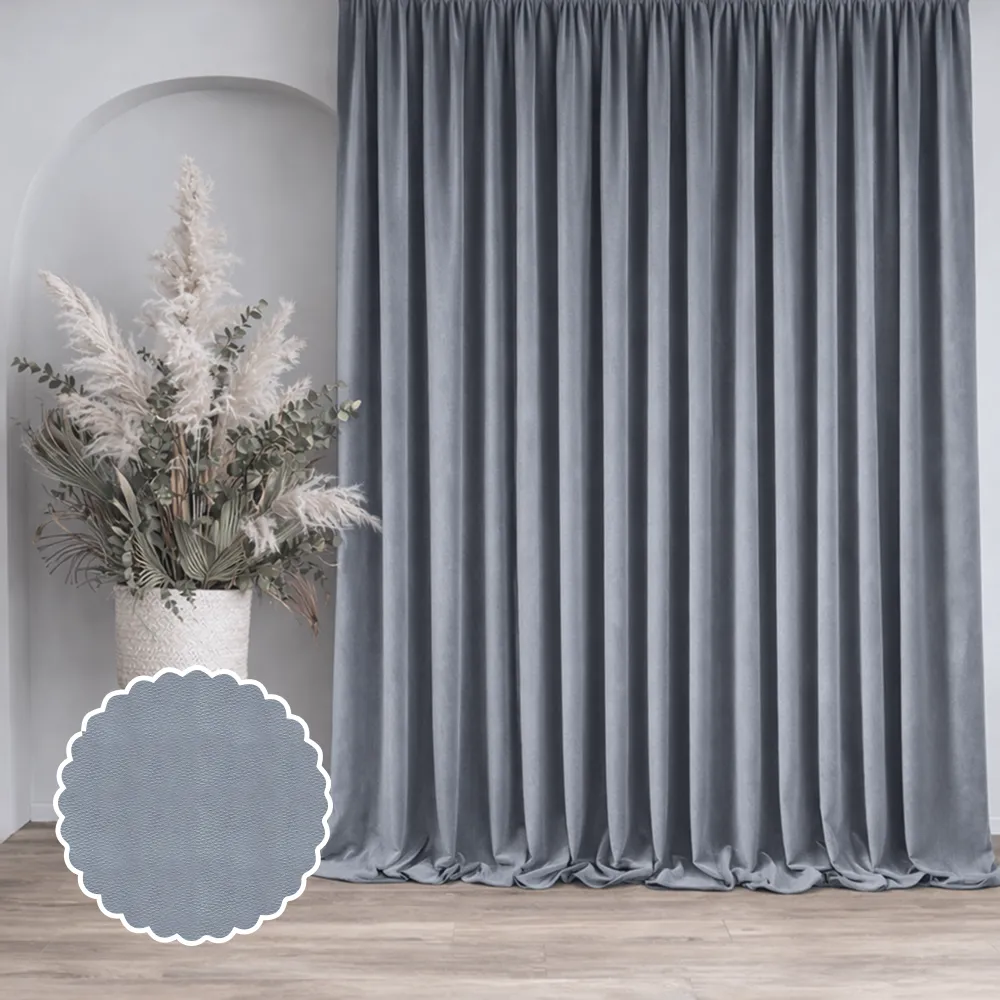
Velvet's pile structure gives it two properties that no flat-weave fabric matches at the same price point: acoustic absorption and visual depth. The pile catches and absorbs sound energy across a broad frequency range, making velvet the most effective acoustic curtain material in residential use. And the directional way the pile reflects light — changing appearance as the angle of light shifts through the day — creates a visual richness that photographs and presents in person better than any other curtain fabric.
In Dubai's context, velvet is well-suited to climate-controlled interiors (the "too warm for a hot country" objection doesn't apply in a 22°C apartment) and it takes blackout lining excellently. The practical constraints are weight (heavyweight cotton velvet panels for large windows can be 15–25kg per pair, requiring heavy-duty tracks and motorized operation), and maintenance (velvet should not be machine-washed — professional steam cleaning is required).
Polyester velvet covers the widest colour range and suits most Dubai residential applications. Cotton velvet is the premium specification — richer in colour depth, with a longer pile life and a hand that improves with age. For formal living rooms, master bedrooms, and dining rooms in Dubai villas and penthouses, cotton velvet is the fabric that creates the most consistently admired curtain installations in the market.
Sheer, Voile, and Net: Light Filtering for Dubai Living Rooms
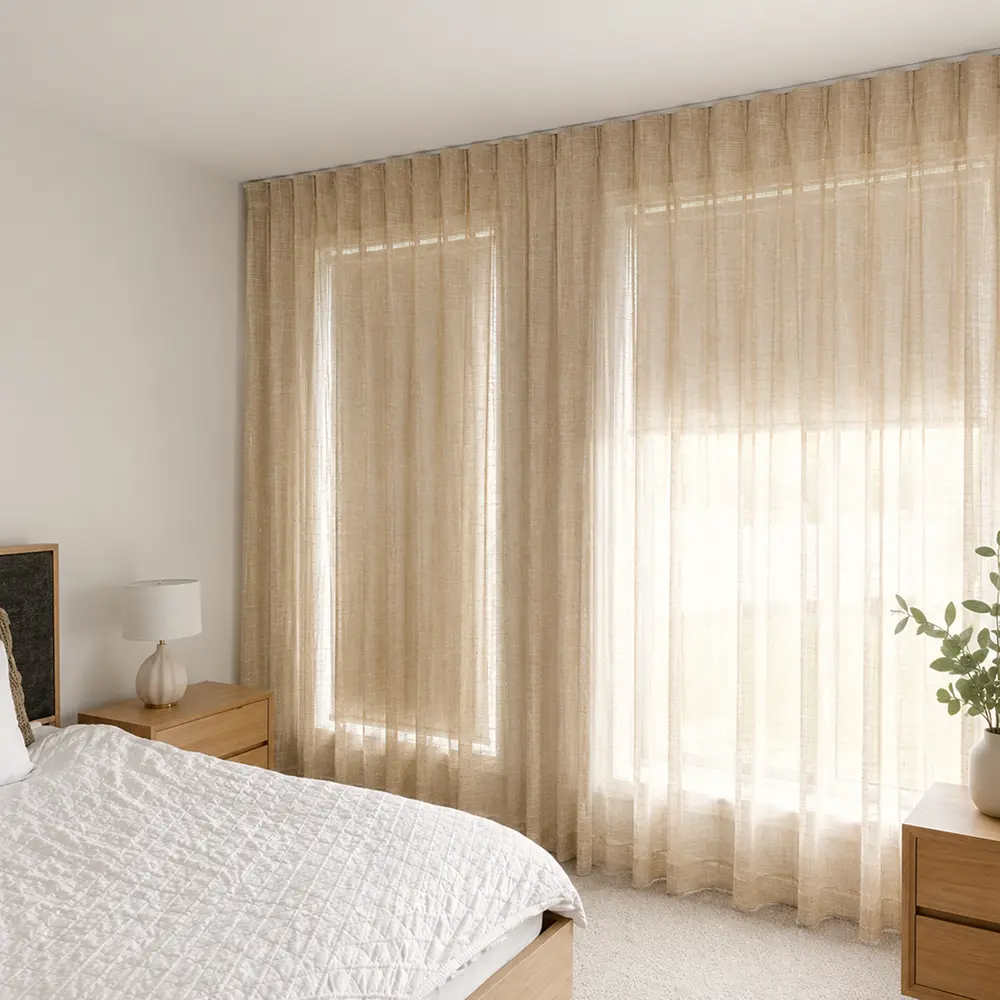
Sheer fabrics are lightweight, open-weave or voile-construction textiles designed to filter and diffuse light rather than block it. In Dubai, sheers perform better than in most other markets because the city's high exterior light intensity means that even a relatively open-weave sheer provides effective daytime privacy — the room interior appears darker from outside than inside.
The main sheer categories used in Dubai are: polyester voile (the most common, least expensive, available in every colour and width — choose UV-stabilised versions for direct sun applications); linen-look sheers (a linen-textured polyester that replicates the natural quality of linen at lower cost and weight); natural linen sheers (true lightweight linen, typically 180–220 gsm, with the anti-static and temperature-moderating properties of natural fibre — the premium sheer option for Dubai living rooms); and net curtains (tighter weave than voile, providing more privacy at the cost of some light quality — less commonly used in premium Dubai interiors but practical for lower-floor apartments).
Sheers in Dubai are almost always used as the inner layer of a double-track system, paired with a heavier fabric or blackout layer on the outer track. The sheer handles daytime light management; the outer layer handles privacy, heat gain, and evening blackout as required. Specifying a sheer without considering the outer layer is an incomplete curtain specification for most Dubai rooms.
Technical Blackout Fabrics: Performance Over Aesthetics
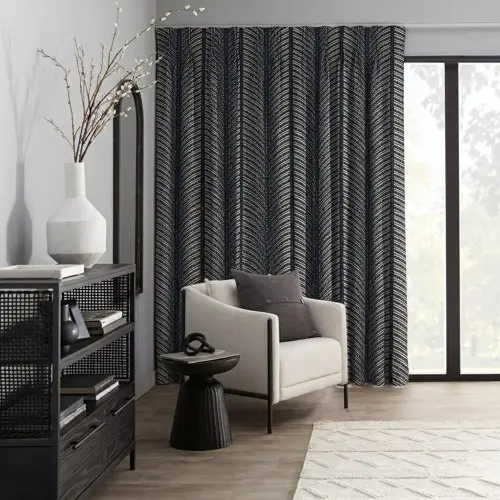
Technical blackout fabrics are engineered specifically to block light — the blackout performance is built into the fabric construction itself rather than achieved through a separate lining. Triple-weave blackout (three interlocked layers, often with a foam core) is the most common construction, achieving true Class 4 blackout (1% or less light transmission) in any colour from white to charcoal.
The advantage of technical blackout over a face fabric with blackout lining: the fabric hangs as a single layer, draping more naturally and feeling lighter than a lined panel. It is also typically easier to maintain — most technical blackout fabrics can be machine-washed, whereas blackout-lined panels require professional cleaning. The limitation is aesthetic: technical blackout fabrics have less textural interest and visual richness than premium face fabrics like linen or velvet. They are the right choice where performance is the priority and budget is a constraint — guest bedrooms, children's rooms, rental properties, and any room where absolute blackout takes precedence over interior design considerations.
Technical blackout is also the fabric of choice for home cinema rooms, where the goal is maximum light elimination at every time of day. A dedicated home cinema using technical blackout in charcoal or near-black on every window achieves a screen-contrast environment comparable to a commercial cinema at a fraction of the cost.
Cotton, Silk, and Synthetic Blends: Completing the Range
Cotton is a versatile, breathable natural fabric that takes colour well and is easy to maintain. Pure cotton curtains are less common in Dubai's premium residential market than linen (which has better anti-static properties and a more contemporary texture aesthetic) but are widely used in casual and family spaces. Cotton with a blackout lining is a practical, value-for-money bedroom specification. Cotton's main constraint in Dubai is UV sensitivity — unlined cotton fades noticeably in direct sun within one to two seasons.
Silk and faux silk create an exceptionally lustrous, light-reflective surface. Pure silk is delicate and requires careful maintenance; it is used primarily in formal traditional interiors (majlis rooms, formal reception halls) where its sheen and lightness suit the space. Faux silk (polyester with a silk-like weave and finish) delivers the visual quality of silk at lower cost with easier maintenance. Both fabrics are sensitive to direct sun — UV degradation causes colour shift and fabric weakening rapidly without a quality lining.
Synthetic blends (polyester-linen, polyester-cotton, viscose blends) occupy the most commercially active price range in Dubai's curtain market. They offer visual approximations of natural fabrics at lower cost. The key constraint is static: most synthetic blends generate static in Dubai's dry AC environment and actively attract desert dust. For high-traffic rooms and busy households, the maintenance burden of frequently dusty synthetic curtains often makes the premium for natural fabrics worthwhile over a 5–10 year horizon.
How to Choose: A Fabric Decision Guide for Dubai Rooms
Match the fabric to the room's primary requirement, then choose the specific fabric that fits your aesthetic and budget within that category:
Master bedroom: blackout-lined linen (natural, tactile, premium) or technical blackout fabric (performance-first, lower cost). Velvet with blackout lining if acoustic comfort is a priority.
Living room (main layer): medium-weight linen with standard or blackout lining. Velvet for a formal, statement living room. Cotton or synthetic blend for rental properties and budget-conscious specifications.
Living room (sheer layer): linen sheer for the premium specification; polyester voile for the practical specification. Pair with the main layer on a double track.
Children's room: technical blackout fabric (practical, washable, available in colours children like) or blackout-lined cotton in a colour or pattern the child chooses.
Formal dining room or entrance hall: heavyweight linen with interlining, or cotton velvet with interlining. Pinch pleat heading for these spaces.
Home office: medium-weight linen, unlined or standard-lined. Anti-glare, not blackout — the goal is softening, not eliminating, the light.
- Linen is the Dubai market default because it doesn't attract desert dust (no static), takes every lining, and suits the dominant interior aesthetic
- Technical blackout fabric is performance-first — suitable for bedrooms and cinema rooms where aesthetics are secondary to function
- Velvet provides the best acoustic absorption of any curtain fabric — the right choice where noise reduction matters as much as light control
- Sheers in Dubai work better than in other markets because high exterior light intensity creates privacy even through open-weave fabric
- Synthetic blends generate static in Dubai's dry AC environment and attract desert dust — the main argument for natural fabrics in high-traffic rooms
- Always ask for the mill name and country of origin for linen — "European linen" without a mill name is not a verifiable quality claim
Frequently Asked Questions
Get Expert Advice at Your Home — Free
Our specialist brings samples, measures every window, and gives you a written quote — no obligation.