
Dubai's 5:30am summer sunrise makes blackout curtains a genuine necessity for every bedroom in the city. Here's what "blackout" actually means, what to look for, and how to choose right.
Why Blackout Curtains Are Non-Negotiable in Dubai Bedrooms
Between late April and mid-August, Dubai's sunrise occurs before 5:30am. By 6:30am, the morning light is intense enough to illuminate a room as effectively as overhead lighting. In a bedroom with non-blackout curtains, anyone who wants to sleep beyond 6am is relying on the fabric to hold back the equivalent of a floodlight — and most fabrics fail this test completely.
The UAE's lifestyle pattern compounds the problem. Dubai's working week runs Sunday to Thursday, with Friday and Saturday as the weekend. The active social culture means late nights are common — and the morning light that would be a gentle signal to wake up in a London bedroom becomes an aggressive intrusion in Dubai. The combination of late nights and very early natural light makes blackout performance in the bedroom not a preference but a practical necessity for sleep quality in this city.
Beyond sleep, blackout curtains in Dubai deliver a thermal benefit that has a direct financial return. South and west-facing bedroom windows in summer receive intense direct solar radiation for 4–8 hours per day. A proper blackout curtain reduces heat gain through those windows by 30–40%, reducing the load on the bedroom air conditioning unit. Over a UAE summer, this is a meaningful reduction in electricity consumption — and because Dubai's peak DEWA rates apply during peak daytime hours, the reduction happens at exactly the right time.
What "Blackout" Actually Means — and the Claims to Watch For
In the Dubai curtain market, the word "blackout" is applied inconsistently — and this inconsistency is one of the most common sources of disappointed purchases. The term technically means 100% light blocking: a certified blackout fabric or lining eliminates all light transmission through the fabric itself. But the term is frequently used in the market to describe fabrics that achieve 85–95% light reduction — significantly better than standard fabrics, but falling well short of complete darkness.
The practical difference between "blackout" (100%) and "room darkening" (85–95%) is significant in a Dubai bedroom. A room with 95% light reduction still admits enough light on a bright Dubai morning to clearly see the furniture in the room — the curtain reduces the light from overwhelming to merely bright. This is not adequate for quality daytime sleep, which is why the specification needs to be confirmed explicitly before ordering.
Ask any supplier to confirm whether their "blackout" fabric or lining is rated to BS EN 13120 Class 4 (1% or less light transmission) or an equivalent certified standard. This is the technical definition of blackout — zero visible light through the fabric. Room-darkening fabrics are typically rated to Class 3 (6% light transmission) or Class 2 (20%), both of which are meaningfully better than standard but not true blackout.
Triple-Weave vs Coated Blackout: The Key Difference
True blackout performance is achieved through one of two construction methods, and understanding the difference helps you choose the right product for your specific situation.
Triple-weave (woven blackout) fabric achieves light blocking through the density and construction of the fabric itself — typically three interlocked weave layers, often with a foam or cotton core. The key advantage is that the blackout is integral to the fabric: there is no separate lining, no potential for the lining to separate or delaminate over time, and the fabric typically drapes and handles like a standard fabric rather than feeling stiff or plasticky. Triple-weave blackout is particularly popular for bedrooms where the face fabric needs to look and feel refined, as it tends to have a more natural drape than coated alternatives.
Coated blackout lining applies a blackout coating to the back of a standard face fabric. The coating — typically a white or pale foam sandwiched between the face fabric and a sateen backing — blocks light regardless of what face fabric is used. The major advantage is versatility: any fabric in any colour or texture can be upgraded to blackout performance by applying a coated lining. The potential drawback is that coated linings can crease if not hung correctly, may have a slightly stiffer hand than the face fabric alone, and in lower-quality products may delaminate (the coating separating from the fabric) after prolonged exposure to moisture or very high heat.
Our recommendation for Dubai: for fabrics specifically designed as blackout (technical blackout fabrics in plain or textured weaves), triple-weave is the better choice. For premium face fabrics (European linen, velvet, patterned fabrics) where you want both the fabric and the blackout performance, a high-quality coated lining from a reputable manufacturer is the practical solution.
Choosing Colours and Fabrics for Dubai Bedrooms
A common misconception about blackout curtains is that they must be dark to achieve blackout performance. This is not the case. Both triple-weave and coated blackout constructions are available in the full colour spectrum, from pure white to deep charcoal. The colour of the face fabric has no effect on the blackout performance of a correctly specified lining or triple-weave construction.
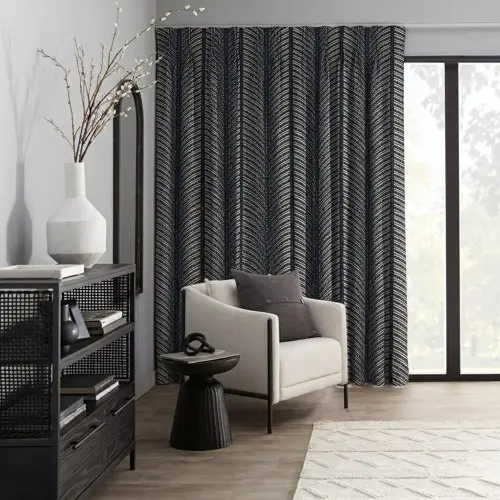
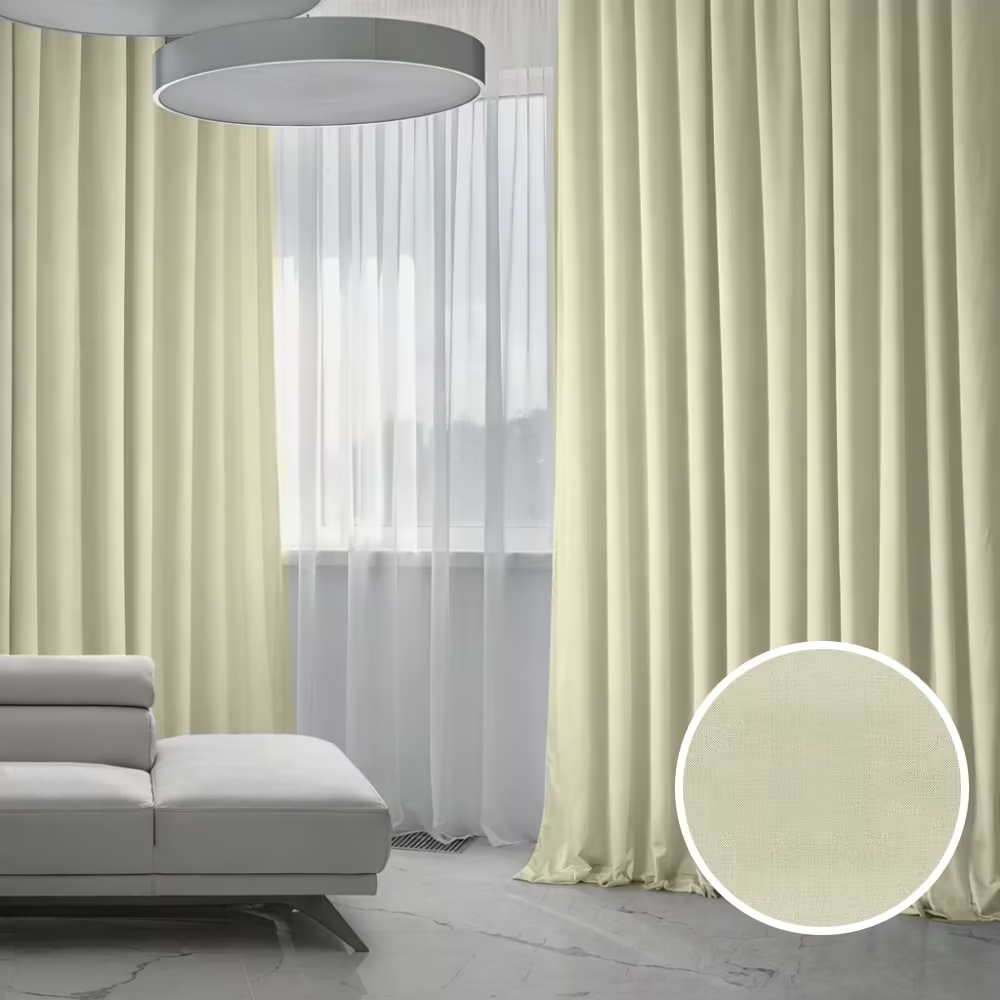
For Dubai bedrooms specifically, the most popular blackout curtain choices are: natural and cream tones in linen with blackout lining (the warm, calm quality of the fabric with full performance — by far the most popular choice in the market), charcoal and dark grey in wave heading (the dramatic contrast with white walls that defines the luxury hotel aesthetic many Dubai residents aim for), and navy in wave heading (a sophisticated alternative to charcoal that is growing in popularity across premium developments).
Light-coloured blackout curtains (white, ivory, pale grey) perform identically in terms of light blocking but create a different visual environment in the room when drawn: the room appears lighter and more spacious. This matters more in smaller bedrooms — a JLT studio apartment benefits more from light cream blackout than from the charcoal that might look spectacular in a Palm Jumeirah villa master bedroom.

Blackout for Children's Rooms, Nurseries, and Shift Workers
Children's blackout requirements in Dubai are even more critical than adult bedrooms. A young child who wakes at 5:30am when light enters their room in summer will disrupt the sleep of the whole household. The investment in proper blackout for a nursery or young child's bedroom is one of the highest return home improvements available in Dubai — measured in hours of uninterrupted sleep for both the child and parents.
For children's rooms, a fun, characterful face fabric with a coated blackout lining is the standard approach — the room feels cheerful and age-appropriate during the day, but achieves complete darkness for sleep. For toddlers and young children who might associate darkness with fear, a star or constellation motif blackout fabric that shows patterns when a nightlight is present can work well psychologically while still providing the required performance.
For shift workers and residents who sleep during the day (a significant population in Dubai's hospitality, healthcare, and security sectors), genuine blackout performance is a genuine occupational requirement. For this application, we recommend paying particular attention to edge sealing — the light that enters around the sides and top of curtains rather than through them. A ceiling-fitted track that allows the curtain to sit close to the wall, or a curtain with side returns, eliminates this edge bleed and achieves the most complete darkening possible.
- Dubai's sunrise before 5:30am makes genuine blackout (not room-darkening) essential in every bedroom
- True blackout means Class 4 (BS EN 13120) — 1% or less light transmission. Always confirm this specification before ordering
- Triple-weave blackout (light blocked by the fabric construction) drapes more naturally than coated alternatives
- Blackout performance is not affected by fabric colour — white and cream blackout work just as well as dark fabrics
- Children's blackout in Dubai pays back in sleep quality for both child and parents — a high return-on-investment upgrade
- For shift workers, edge sealing (ceiling-fitted track, side returns) eliminates the light that enters around the curtain edges
Frequently Asked Questions
Get Expert Advice at Your Home — Free
Our specialist brings samples, measures every window, and gives you a written quote — no obligation.